Stonebreaker is a brick breaker with fifty-nine walls, and the rule while building it was one new idea per wall, nameable in five words. So one wall runs Conway's Game of Life. One is a flock of starlings. One turns gravity ninety degrees every six seconds, and one deforms the screen itself as you break it.
The paddle, the ball and the wall of bricks are from 1976, and Stonebreaker does not pretend otherwise. What it does with them is the point. Fifty-nine walls are in play, seventeen more were built and retired, and the ones worth your time are not the ones that look like a wall of bricks.
Free, in a browser, on four arrow keys and the space bar.
The bump, and who it belongs to
Up lunges the paddle upward. Meet the ball on the rise and it leaves spiked, faster and hard enough to crack iron-capped driven stone that an ordinary ball only rings off. Miss the timing and the paddle overshoots below its rest line and cannot bump again until it settles.
Position is the old skill. This one is timing, which is the whole reason it is in there. It is not an original idea and the source code says so: it is Funkiball's one great idea, and it is borrowed with the credit attached.
Where it came from
Stonebreaker was built on 5 August 2026, three weeks into Alderhoard, as a brick breaker standing in the Town Square of a valley that already existed. It was not the plan. The valley was the plan, and the arcade in it was supposed to be a reward for finishing things in the valley. The arcade ate the project.
The ancestor is the brick-breaking game Atari put out in 1976: a paddle, a ball, and a wall that never changed. Fifty years later the genre still mostly ships that same wall with new colours on it, and the interesting question is what happens if you refuse to.
So the law from the first week was one new idea per wall, and the idea has to be nameable in five words. That rule is the reason there are fifty-nine walls rather than nine variations. It is also the reason seventeen were scrapped: a wall whose idea could not survive being said out loud was a wall not worth keeping.
The walls came in bursts. Tunnels, cats and eggs in the first week. Pinball and false perspective by the middle of August. Real flocking on 18 August, in a wall where nothing dies. The rites engine and the shifting wall the day after. By early September it had stopped being a brick breaker with gimmicks and started being a place to put simulations that happen to have a ball in them.
Fifteen walls were renamed on 7 September, all in the same direction: from the atmospheric to the literal. THE CLUTCH became THE EGGS, THE QUARRY FIELD became THE RANDOM WALL, THE ZING became THE ROTORS, THE UNSEEN became INVISIBRICKS. The reasoning was that a player should be able to read the menu and know what they are about to play. The old names are still in the code, mapped, because a shared link should never rot.
Walls that are running a simulation
Six of these are real models, not animations on a timer. They would keep doing what they do if you put the ball down and walked away.
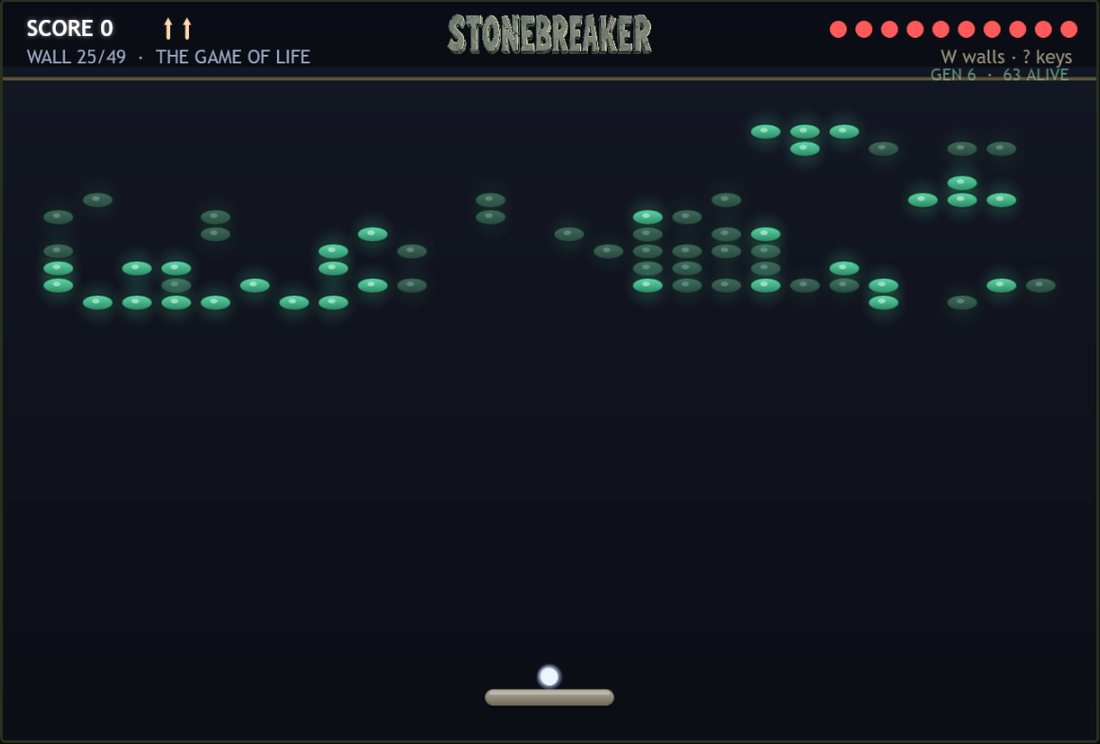
No. 25The Game of Life
Conway's Game of Life, played as a wall. Births, deaths and still lifes, stepping every eighty-eight frames while you try to break it.
Cells that the rules kill score you nothing, because the rules killed them and not you. Before each step, every cell that is about to die is dimmed, so the wall tells you what it is about to do. Those marks are a hint and not a contract: your own kills in between steps redraw everybody's fate. The bottom row is left clear as a trap channel, and births are refused on any cell the ball is sitting in.
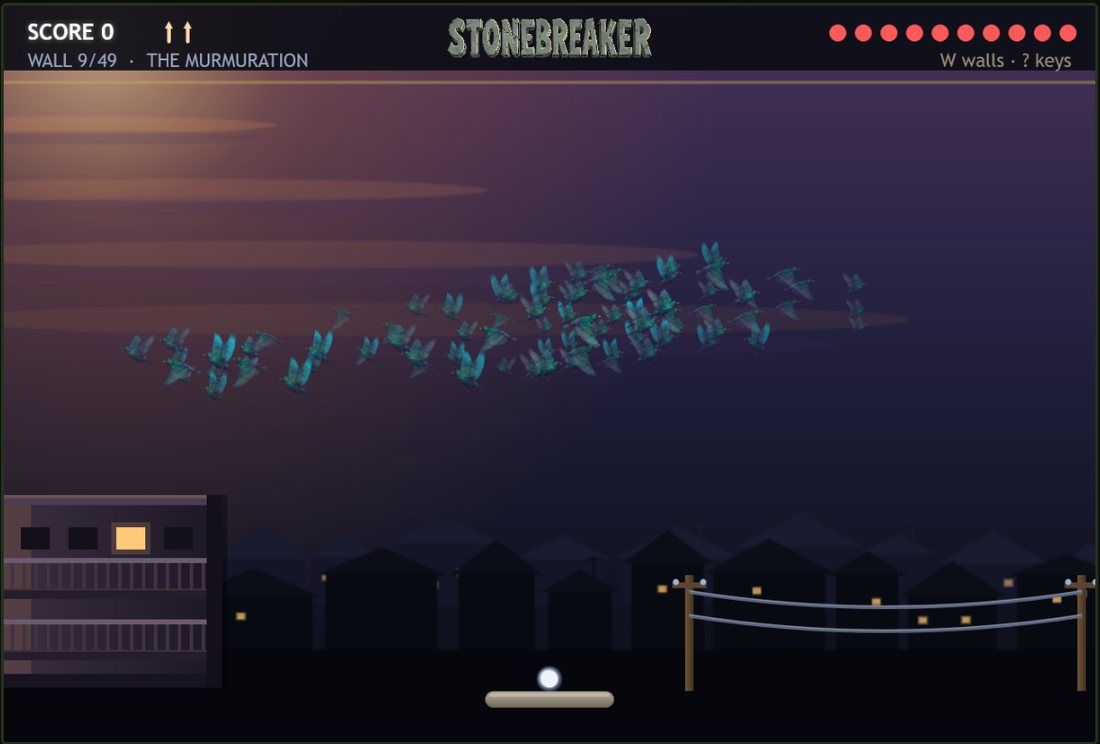
No. 9The Murmuration
A flock of eighty starlings, flying as one shape, drawn as the wall you have to break.
The flock wanders, wheels about its own centre, breathes in and out, and carries a travelling compression wave along its long axis so the birds bunch at the crest. It is posed off six sine frequencies with no small common multiple, which means the combined shape takes the best part of an hour to come near repeating itself. Nothing dies. A bird you hit is not removed, it flies off to a roost on an apartment parapet and two sagging telephone wires at the side of the screen, and the filling roost is the progress bar.
No. 38Brownian Motion
Seventy visible molecules drift around the board, and every one of them turns the ball a little when it touches it.
The molecule does not shove the ball, it rotates it, by up to a tenth of a radian. That is not a shortcut, it is the honest physics: a particle that light cannot speed a ball up, it can only change where the ball was going. Every collision throws a small puff so the deflection always has a visible cause, and the molecule recoils off it.
No. 56The Petri Dish
A culture creeps across the agar one cell every half second, and it never moves at random.
It grows by the same rule a burrowing grub uses: try left, then straight ahead, then right, then back. Chipping the colony down cell by cell is the beginner's move and the worst-paying one. Killing cells leaves dead crust the culture cannot grow back through, so the real play is to fence a colony in. Seal one off with nowhere left to go and the entire thing crystallises at once and pays forty points a cell.
No. 41The Magnet
Every brick is dealt a magnetic pole at load, and then the wall is left to sort itself out.
It is an honest all-pairs calculation: every brick against every other brick inside range, opposites attracting and likes repelling, with a short-range body repulsion so stone never compresses tighter than it physically fits. Motion is damped and capped, with a little wander noise so it never quite locks into equilibrium. The ball is completely ordinary. The stone is the thing that has gone strange.
No. 39Jittery
Three hundred and thirty-six loose ten-pixel cubes rattle around between three fixed steel girders.
This is Brownian Motion turned inside out. There, the ball was pushed around by the board; here the stone wanders and shoves itself about and the ball is the only steady thing on the screen. The cubes can never drift below a floor line, so the wall cannot dissolve into the paddle.
No. 50The Reactor
Hit a brick and it heats. Heat spreads to its neighbours. Too hot and it lights a fuse and bursts into everything around it.
A bursting brick breaks regardless of how many hits it had left and throws heat into all eight cells around it, which is how a chain gets going. Steel control rods split the core into three chambers and pass no heat at all, so a cascade stays in the chamber you started it in. The first build of the heat overlay was scrapped because an orange wash reads as a differently coloured brick rather than a hot one.
No. 47Earthquake City
Towers of brick standing on bare ground, with no steel anywhere to hold them up.
Knock out a brick that was carrying weight and the tower above it comes down through itself. A falling brick that lands cracks rather than shattering, so a collapse is a slow structural failure and not a special effect. Every nine seconds the ground shakes on its own and loosens three more.
Walls that change the physics
The engine normally renormalises the ball's speed every frame. These walls are the ones allowed to break that rule.
No. 34Antigravity Factory
Gravity turns ninety degrees every six seconds. Down, then left, then up, then right, forever.
A compass dial on the wall shows which way is currently down and counts to the next turn, so this is a wall about planning rather than reflexes. The pull bends the ball's path rather than adding raw speed to it.
No. 35Vulcan Gravity
The one wall that turns off speed renormalisation and does real projectile arithmetic instead. The ball has weight and never gets its speed back.
Launch speed and gravity are tuned so a dead-straight shot only just reaches the top course. The SLOW pill scales your paddle speed by a bit over half, and because apex height scales with the square of speed, that leaves you about a third of the height. A terminal velocity cap was added on the way down only, because the ball would otherwise fall faster than the paddle can travel. One rule came out of testing it and now governs the whole wall: steel must never close the bottom of a pocket. A stone pocket is always escapable because the ball eats its way out. A steel one is not.
No. 49The Wormhole
Three black holes orbit each other above the wall. A ball that falls into one comes out of the next, travelling the same direction at the same speed.
They sit in the top fifth of the field, above the bricks, and the bricks were dropped four courses to make room. That is the whole design: the holes only ever take a ball you have already got past the stone, never one falling back toward your paddle.
No. 51Neutron Star
Two black holes spiral into each other, merge in a flash, and the wall is what sprays out of it.
The bricks fly out along a logarithmic spiral arm and settle into a galaxy. Then the merged star stays exactly where it is for the rest of the level, as a gravity well bending every shot you take.
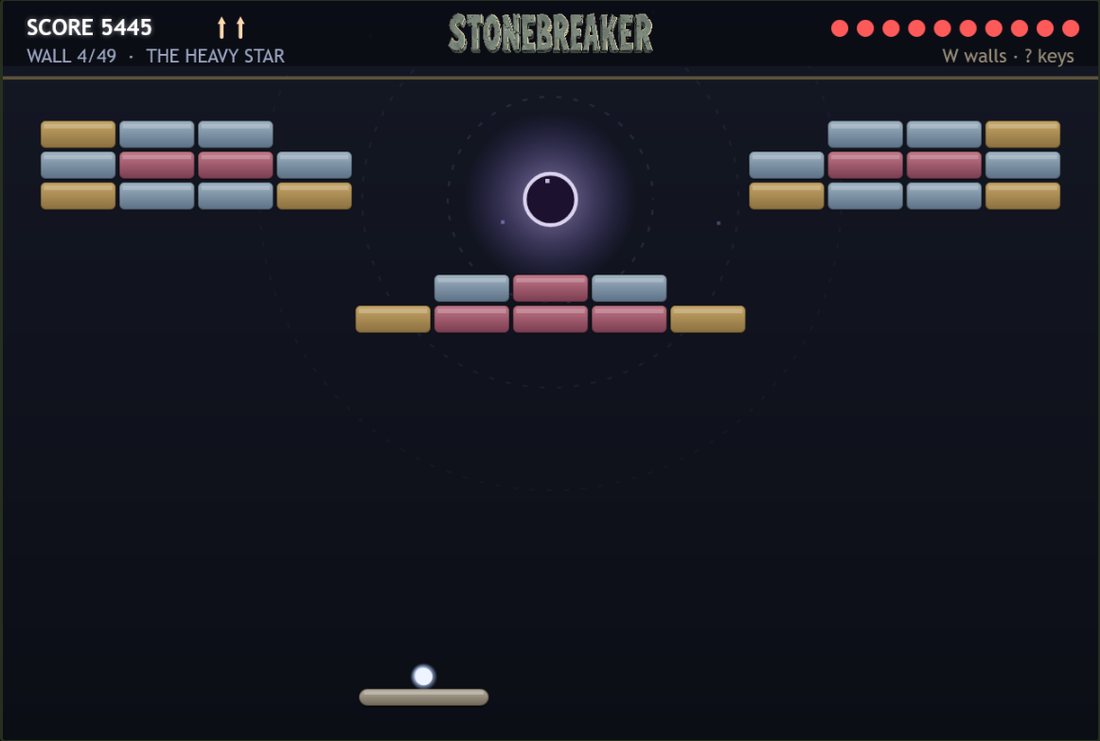
No. 4The Heavy Star
A single dense star hangs near the top of the screen and bends the ball with an inverse-square pull.
This is the oldest of the gravity walls and the mechanism underneath three of the others. The pull is capped per frame and never divided by a distance small enough to run away, and a ball that reaches the core is mirrored off it.
No. 54Dyson Sphere
A shell of steel turns around a still oval of gold. You hit the gold through the gaps as they come round.
The shell bricks are spaced by arc length around the ellipse rather than by angle, because spacing them by angle would have made the long flat top all gap and the tight ends all steel.
No. 53The Vase
A glazed vase, half full of tiny gold bricks. The mouth is the only way in.
There is a tiny black hole at the bottom of the vase with the strongest pull in the game, and it is the only gravity well in Stonebreaker whose reach runs out. Get a ball in through the neck and the hole keeps dragging it back down through the gold.
Walls that attack the screen instead of the ball
Nothing in this group changes how the ball behaves. They change what you are able to see, which turns out to be harder to play against.
No. 43Reality Breakdown
Three ordinary brick towers, deliberately recognisable, and then the field itself starts to deform as you break it.
Four distortions run at once and each earns its way in as the wall comes down: the field breathes wider and narrower, the corridors shear sideways, the whole picture stretches thinner and taller, and every seven seconds or so one of the three steel floor slabs picks a new offset and slides forty-six pixels sideways. Not one offset in it moves anything vertically. Break the red cap and the whole breakdown snaps to full strength for thirteen seconds regardless of how far in you are.
No. 57Reality Breakup
The same wall on half-size stone, bending twice as far and twice as fast, over a code-drawn sky that will not hold still.
The breathing is swapped out for a rippling of the gaps themselves, so the grey slabs stop pulsing and the spaces between them move instead.
No. 23Invisibricks
A hundred and forty-two bricks that draw absolutely nothing. Play it by sonar.
A strike pings a brief outline. A break gives every brick within two cells one per cent of permanent visibility. One per cent is the specification, not a placeholder: the wall never becomes clear, it becomes a rumour you slowly learn to trust. The bricks sit on a moiré interference pattern, so what emerges has a shape.
No. 52The Rotating Wall
A square box with steel on three sides and one way in. Every ten seconds the whole thing turns a quarter turn and the opening moves.
While it turns, the ball is held perfectly still and waits. The wall was close to unwinnable on its first build, so every completed turn now also drops a fireball out from underneath.
No. 20Smaller and Smaller
Bricks do not break when you hit them. They shrink about their own centre.
A brick that finally pops sends a ripple that shrinks its four neighbours one size each, seven frames later, one step deep.
No. 45Growth Spurt
The mirror of it: every brick on the wall is perpetually swelling back toward full size, and a hit knocks it back down.
Full size is only the ordinary cell size, so a wall you have neglected is never more closed than the map you started with. It just stops being nearly finished.
Walls that are not brick breakers at all
Same cabinet, same five keys, no bricks.
No. 13The Diet
No ball. Food falls out of the sky and the paddle catches it. Catch the good, dodge the junk.
Scored plus one and minus one over a three-minute run, and junk costs a life. It is the only mode in the cabinet where the paddle is the whole game.
No. 30The Long Wall
Five minutes of endless Stonebreaker that cannot kill you. Courses form at the top and creep down, faster every time you clear one.
Nothing costs a life here. A lost ball or a landed course costs you a hundred and fifty points instead. No steel is ever generated, because an unbreakable course could never be cleared. Clearing a whole course buys you a pause, and some courses carry a REST brick that buys a longer one. It ends on a certificate with a server-minted serial number, and putting that on the public board is opt-in.
No. 29The Pillows
Bricks that soak the ball up instead of returning it, and a cat asleep in the bedding.
Hit one and the ball crawls for the best part of a second. Hit a second one while it is still soft and the ball sinks in and stops dead. At which point the cat gets up, walks over, and bats it free.
No. 12The Jellies
Soft round bodies with real gravity, piled on a gapped steel shelf. The ball alone can never finish one.
Only a weapon ends a jelly: a laser, a bolide, a bomb, a keg or the death ray. The wall carries the one hint card in the game written by Scott himself, and it says Remember — There's 2 In The Chamber.
No. 17Balloons
The same bodies with gravity flipped upward, piling against the ceiling instead of the floor.
A steel grille under the pile means you have to stand somewhere particular to get a shot at them.
No. 46The Volcano
A steel cone in the middle of the screen that floods the sky with tiny bricks and then keeps sending more up.
It draws from a fixed supply, and the level refuses to declare itself won while any of them are still in the air, so the wall can always actually be finished.
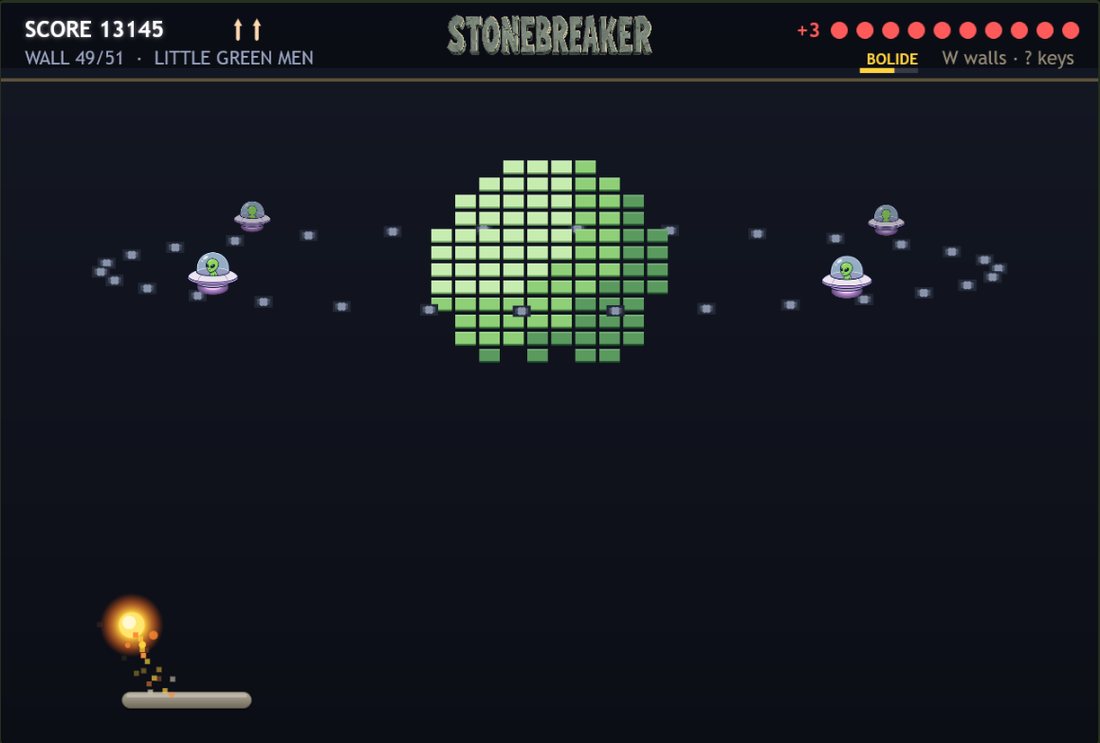
No. 48Little Green Men
A planet of green minibricks inside a wide steel ring that turns around it, with flying saucers riding the ring.
The near half of the ring draws in front of the planet and the far half behind it. Knock a saucer and it scores and beams away and comes back later. Nobody is hurt. The bomb powerup is suppressed on this wall, because a three-cell blast would clear the entire planet in one go.
The Warlord
The last wall, and it stays shut until you have solved twenty others. It is not in the running order at all: it is appended last by construction, so it lands at the end no matter how the other walls are shuffled.
Its eye opens for a hundred and twenty frames out of every three hundred and sixty, and hits only land while it is open. It rebuilds a shield brick every five seconds. It lobs embers that burn the floor where your paddle wants to be.
There is a wall builder in there
Z opens it. You draw a wall by mouse, pick its features, test it without leaving, and save it. It uses the same feature keys the shipped walls use, so a wall you draw can have gravity, or magnetism, or the Game of Life running in it.
Y wallpapers whichever wall you are on, and the question mark lists the lot.
Seventeen walls were built and then retired
They are still in the file. Nothing is deleted, because every table in the cabinet is keyed by the order walls were authored in, and pulling one out would shift every index after it.
Some were retired for being unfair, some for being dull, and one for being a five-times oversized beach ball that ploughed furrows through a sheet of cubes and turned out to be more fun to describe than to play. Among the others: a wall that measured ball temperature instead of speed and used the ball's own colour as the readout, a wall whose courses hung from iron pins on a catenary and fell when you cut both, a wall with a second gutter along the ceiling guarded by a slab that tracked your own movements, and a skull whose steel teeth outlived it and stayed hanging in the dark.
The walls, in the order you meet them
Fifty-nine walls are in the running order. These 55 have a direct link, and each one opens straight onto that wall.
- 1Two Cats
- 2The Random Wall
- 3Hornets
- 4The Heavy Star
- 5Pillars
- 6The Hopper
- 7The Bellows
- 8The Eggs
- 9The Murmuration
- 11The Vault
- 12The Jellies
- 13The Diet
- 14Blockhead
- 15The Bumpers
- 16The Melt
- 17Balloons
- 18The Anvil
- 19The Rotors
- 20Smaller and Smaller
- 21The Starfall
- 22Half Balloons
- 23Invisibricks
- 24Tiny Bubbles
- 25The Game of Life
- 26Square One
- 27The Mason's Yard
- 28The Invasion
- 29The Pillows
- 30The Long Wall
- 32The Fireworks
- 34Antigravity Factory
- 35Vulcan Gravity
- 36The Cups
- 37Champagne
- 38Brownian Motion
- 39Jittery
- 40The Arch
- 41The Magnet
- 43Reality Breakdown
- 44Stuck Balloons
- 45Growth Spurt
- 46The Volcano
- 47Earthquake City
- 48Little Green Men
- 49The Wormhole
- 50The Reactor
- 51Neutron Star
- 52The Rotating Wall
- 53The Vase
- 54Dyson Sphere
- 55The Bubbler
- 56The Petri Dish
- 57Reality Breakup
- 58Columns
- 59The Warlord
Questions
- Is Stonebreaker free?
- Yes, and without an account, an email address or a download. It runs in a browser. At least forty walls are committed to staying free permanently.
- How many levels does Stonebreaker have?
- Fifty-nine walls are in play. Seventeen more were built and retired. The Warlord, the last wall, unlocks after you solve twenty.
- What are the controls?
- Left and right move the paddle, up bumps it, and space launches the ball. That is the whole control scheme, and it is the same across the entire game.
- Which wall should I play first?
- The Game of Life, if you want to see what the cabinet is for. Reality Breakdown if you want to see it misbehave. The Long Wall if you have five minutes and do not want to lose.
- Can I make my own wall?
- Yes. Z opens the wall builder inside the game. You draw by mouse, pick the same feature keys the shipped walls use, test without leaving, and save.
- Does it work on a phone?
- It needs a keyboard, so it wants a laptop or desktop.